Dollar Cost Averaging: The Strategy That Removes Emotion From Investing
Dollar Cost Averaging: The Strategy That Removes Emotion From Investing
The biggest enemy of investment returns is not market crashes, fees, or bad stock picks. It is investor behavior. Study after study shows that individual investors underperform the very funds they invest in — because they buy when markets feel exciting (high) and sell when markets feel scary (low). Dollar cost averaging is the antidote to this pattern.
DCA is the recommended investment strategy in our complete investing roadmap for beginners. This article explains the mechanics and psychology in detail.
How It Works
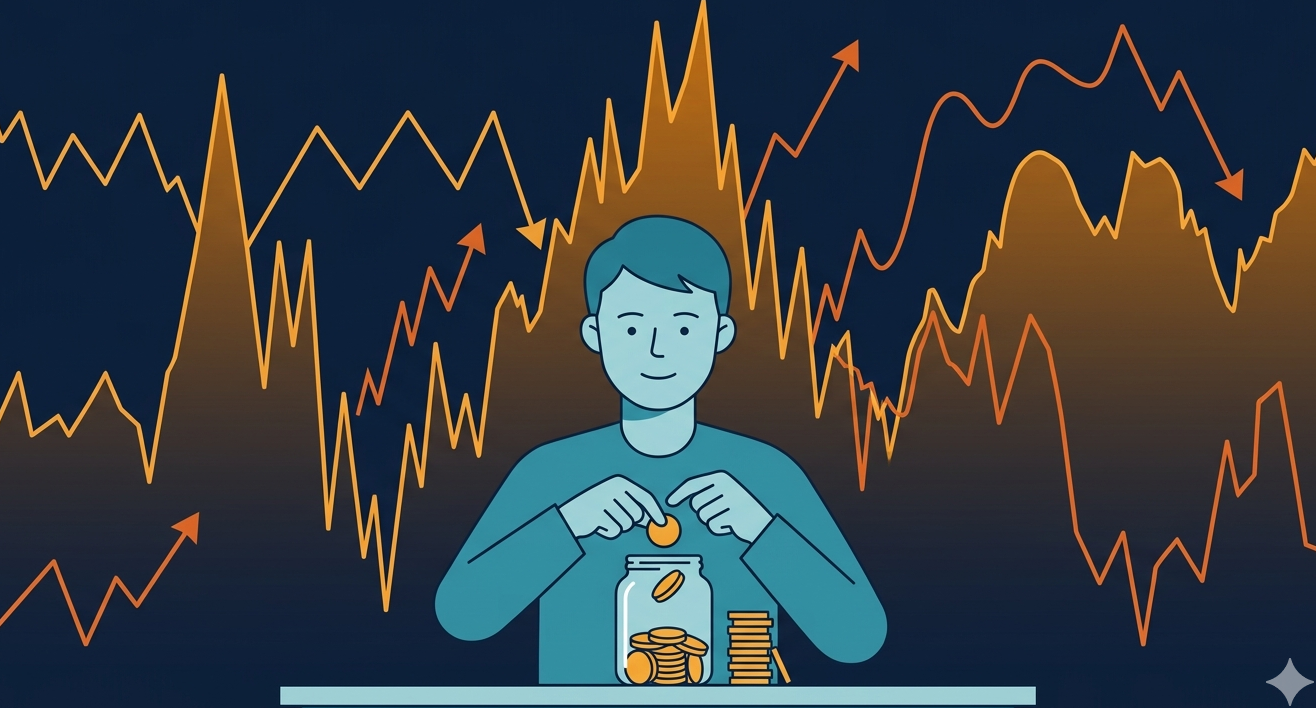
Dollar cost averaging means investing a fixed dollar amount at regular intervals regardless of market conditions. Example: $300 on the 1st of every month into a total stock market index fund. When the market is up, your $300 buys fewer shares. When the market drops, your $300 buys more shares. Over time, your average purchase price is lower than if you tried to guess the right time to buy.
The math is simple but powerful. Imagine investing $300/month over 4 months where the share price fluctuates: Month 1 at $30 (buy 10 shares), Month 2 at $25 (buy 12 shares), Month 3 at $20 (buy 15 shares), Month 4 at $25 (buy 12 shares). You invested $1,200 total and own 49 shares at an average cost of $24.49 — lower than the average price of $25. This is the mathematical advantage of buying more when prices are low.
The Psychological Advantage
The mathematical benefit of DCA is modest. The psychological benefit is enormous. By automating your investment schedule, you eliminate every decision point where emotions could interfere. You never have to decide “is now a good time?” The answer is always: invest on your scheduled date.
This matters because human brains are wired to be terrible at market timing. We feel most confident buying when prices have been rising (expensive) and most fearful buying when prices have fallen (cheap). DCA overrides this instinct by making investing mechanical rather than emotional.
How to Set Up DCA
At your brokerage, set up a recurring automatic transfer from your bank on your payday (or the day after). Then set up automatic investment of that amount into your chosen index fund. Most brokerages (Fidelity, Schwab, Vanguard) support this for both mutual funds and ETFs with fractional shares. Once configured, the system runs without any intervention from you.
The ideal DCA setup requires zero ongoing decisions. Money moves from paycheck to brokerage to investment automatically. You review quarterly or annually to ensure everything is running and to increase your contribution amount if your income has grown.
For the complete investing framework, see our complete investing roadmap.
📘 Recommended: Investing Books for Beginners
The most recommended investing books by financial experts. Start with the classics.
Marcus Chen is a Chartered Financial Analyst with 15 years of experience in asset management and personal finance education.
Last reviewed: March 2026
Financial Disclaimer: This content is for informational purposes only and does not constitute financial advice. Past performance does not guarantee future results. Consult a qualified financial professional before making investment decisions.