ETF vs Mutual Fund: Which One Should You Choose and Does It Matter?
ETF vs Mutual Fund: Which One Should You Choose?
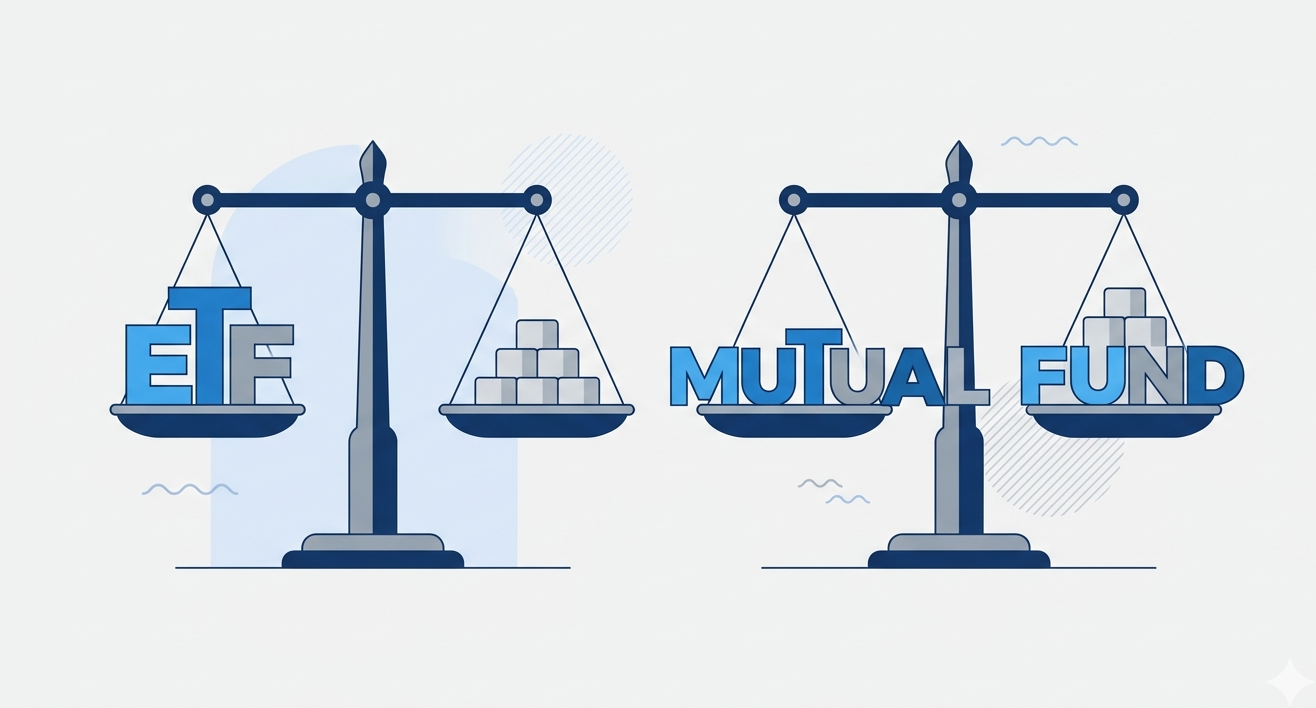
This is one of the most common questions new investors ask, and the honest answer is: for most beginners, it barely matters. Both are vehicles that hold collections of investments. Both can track the same indexes. Both charge similar (very low) fees. The differences are structural, not fundamental — and for a long-term buy-and-hold investor, the impact of those differences is minimal.
This comparison is part of our complete investing roadmap for beginners.
Key Differences
Trading: ETFs trade throughout the day at fluctuating prices. Mutual funds trade once daily at the closing price (NAV). For a long-term investor buying monthly, this makes no practical difference.
Minimums: ETFs have no minimum beyond the price of one share (or $1 with fractional shares). Some mutual funds require $1,000-$3,000 minimum initial investment (Vanguard Admiral Shares require $3,000). Fidelity’s zero-fee index funds have no minimums.
Fees: ETFs typically have slightly lower expense ratios (0.03% vs 0.04% for equivalent funds). The difference on a $10,000 portfolio is $1/year. Negligible.
Tax efficiency: ETFs are slightly more tax-efficient in taxable accounts due to their creation/redemption mechanism that minimizes capital gains distributions. In tax-advantaged accounts (IRA, 401k), this difference disappears entirely.
Automation: Mutual funds are easier to set up for automatic recurring purchases at most brokerages. ETF automatic investing requires fractional share support, which Fidelity and Schwab now offer.
Simple Decision Framework
Use ETFs if your brokerage supports automatic fractional share purchases, you want the absolute lowest expense ratios, or you are investing in a taxable account where tax efficiency matters. Use mutual funds if automatic recurring investment setup is easier at your brokerage, you prefer the simplicity of investing exact dollar amounts, or you are using Vanguard and prefer their mutual fund interface.
Or just pick whichever one you encounter first and start investing. The vehicle matters far less than the habit.
For the complete investing strategy, see our complete investing roadmap.
📘 Recommended: Financial Planning Tools
Emergency fund trackers, savings planners, and financial goal worksheets.
Marcus Chen is a Chartered Financial Analyst with 15 years of experience in asset management and personal finance education.
Last reviewed: March 2026
Financial Disclaimer: This content is for informational purposes only and does not constitute financial advice. Past performance does not guarantee future results. Consult a qualified financial professional before making investment decisions.